or call us at (847) 220-1560

Experienced Employment Based Immigration Attorney for EB-1 Green Card Petitions
Outstanding skills deserve strong legal representation. Our employment-based immigration lawyers help individuals with exceptional accomplishments secure a U.S. Green Card through the EB-1 visa pathway.
Book a Free ConsultationOUR APPROACH
The EB-1 Visa: The Highest Standard in U.S. Immigration
The EB-1 is the only U.S. employment-based visa category where your achievements form the foundation of your case, not an employer’s sponsorship. Designed for individuals with extraordinary ability, outstanding researchers, and multinational executives, it bypasses labor certification entirely. That distinction matters. USCIS scrutiny at this level is among the highest in the immigration system. A missing document, a vague letter of recommendation, or a failure to clearly establish national acclaim can lead to an RFE or an outright denial.
At the Law Offices of Mary Kennedy, our employment-based immigration attorneys do more than prepare filings. We bridge the gap between your achievements and what USCIS demands. As a leading immigration law firm, we translate your life’s work into the precise legal argument the government requires. We do not just file documents. We build a case.


Requirements
EB-1 Visa: Eligibility Criteria
The EB-1 employment-based visa covers three categories. Each carries its own qualifying standards and documentation requirements.
EB-1A: Extraordinary Ability
Open to individuals with national or international recognition in science, arts, business, education, or athletics. No job offer is required.
Applicants qualify through one of two paths. The first is a major one-time achievement, such as an Oscar, Pulitzer Prize, or Olympic Medal. The second is meeting at least three of the following criteria:
- Evidence of judging others’ work in the field
- Published materials about the applicant in major media or trade publications
- Authored scholarly articles in professional or academic journals
- Original contributions of major significance to the field
- Receipt of a nationally or internationally recognized prize for excellence in the field
- Commercial success in the performing arts
- Membership in associations requiring outstanding achievement for entry
- Performance in a leading or critical role for a distinguished organization
- High salary relative to peers in the same field
EB-1B: Outstanding Professor or Researcher
- Reserved for academics with an established international reputation in their discipline.
- International recognition for outstanding contributions to an academic field
- At least three years of teaching or research experience
- A job offer for a tenured, tenure track, or comparable research position at a qualifying U.S. institution
EB-1C: Multinational Manager or Executive
- The petition must be filed by a U.S. employer. The applicant must have:
- Worked outside the U.S. in a managerial or executive capacity for at least one of the three years before filing
- A confirmed role with the same employer, a subsidiary, or an affiliate in the U.S.
- A U.S-based position that qualifies as managerial or executive in nature
Documentation
EB-1 Visa: Required Documents
A missing or incorrect document is among the most common causes of EB-1 delays and RFEs. Our employment-based immigration attorneys guide applicants through the full documentation process to ensure nothing is left to chance.
- 01Applicants will need to submit
- Valid passport
- Two recent U.S. visa photographs
- Government-issued photo identification
- Birth certificate
- Approved Form I-140, Immigrant Petition for Alien Workers
- Form DS-260 confirmation page, if applying from outside the U.S.
- Medical examination and vaccination records signed by an approved physician
- Court or criminal records, if any
- 02To support your EB-1 petition, you must also provide evidence of your achievements:
The strength of an EB-1 petition depends on the quality of supporting evidence. Our employment-based immigration lawyers review each document to ensure it directly addresses the USCIS criteria for your category.
You will also need to provide:
- Documentation of major awards or prizes received in your field
- Published materials about your work in major media or professional publications
- Evidence of membership in associations requiring outstanding achievement
- Reference and recommendation letters from employers, peers, or academic institutions
- Job offer or invitation letter from your U.S. employer, where the category requires it
- Organizational chart confirming your managerial or executive position, for EB-1C applicants
Applicants will need to submit
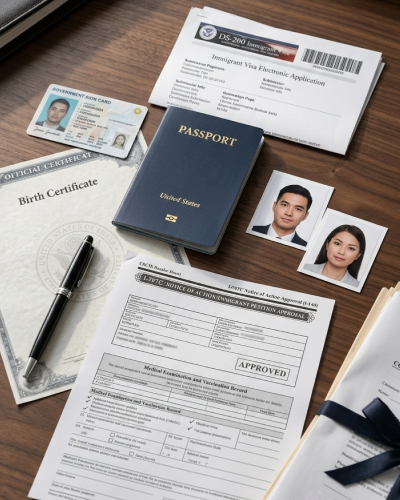
- Valid passport
- Two recent U.S. visa photographs
- Government-issued photo identification
- Birth certificate
- Approved Form I-140, Immigrant Petition for Alien Workers
- Form DS-260 confirmation page, if applying from outside the U.S.
- Medical examination and vaccination records signed by an approved physician
- Court or criminal records, if any
To support your EB-1 petition, you must also provide evidence of your achievements:

The strength of an EB-1 petition depends on the quality of supporting evidence. Our employment-based immigration lawyers review each document to ensure it directly addresses the USCIS criteria for your category.
You will also need to provide:
- Documentation of major awards or prizes received in your field
- Published materials about your work in major media or professional publications
- Evidence of membership in associations requiring outstanding achievement
- Reference and recommendation letters from employers, peers, or academic institutions
- Job offer or invitation letter from your U.S. employer, where the category requires it
- Organizational chart confirming your managerial or executive position, for EB-1C applicants
Benefits
EB-1 Visa: The Benefits
The EB-1 is one of the fastest employment-based immigration routes to U.S. permanent residency. The benefits go well beyond a Green Card.
No labor certification required
Pathway to U.S. permanent residency
Travel in and out of the U.S. without restrictions
No personal financial investment required
Dependent visas for spouse and children under 21
EB-1A applicants can petition without employer sponsorship
FAQ
Your EB-1 Questions, Answered
What is an EB-1 visa, and how does it work?
The EB-1 is an employment-based immigration visa reserved for the most accomplished professionals in their fields. USCIS issues approximately 40,000 EB-1 visas each year. Three categories are available:
- EB-1A: Individuals with extraordinary ability in science, arts, business, education, or athletics
- EB-1B: Outstanding professors and researchers with at least three years of teaching or research experience
- EB-1C: Multinational managers or executives who held that role outside the U.S. within the past three years
EB-1A applicants can file their own petition without employer sponsorship. EB-1B and EB-1C applicants require a U.S. employer to file on their behalf.
Is EB-1 the same as a Green Card?
Not exactly. EB-1 is the immigration category. The Green Card is the document confirming permanent residency once the petition is approved. One leads to the other.
Unlike temporary work visas, the EB-1 grants indefinite authorization to live and work in the U.S. Permanent residency status does not expire, though the physical Green Card must be renewed every 10 years. Once the process is complete, there is no ongoing employer dependency.
Does EB-1 require a medical examination?
Yes. A medical examination by a USCIS-approved physician is mandatory for all EB-1 applicants. The results determine admissibility to the U.S. Applicants may be found medically inadmissible for:
- Presence of communicable diseases of public health significance
- Failure to provide proof of required vaccinations
- History of substance abuse
- Mental health conditions associated with harmful behavior
The examination must be conducted by a USCIS-designated civil surgeon in the U.S. or a panel physician if applying from outside the country.
How long does the EB-1 application process take?
Processing times vary based on category, USCIS workload, and whether premium processing is selected. EB-1A petitions are eligible for premium processing, which prioritizes your petition for a faster USCIS decision. EB-1B and EB-1C timelines are also influenced by the employer’s preparation and the strength of supporting documentation. Our employment-based immigration attorneys assess your case early and keep your filing on schedule.
Can I apply for EB-1 while on H-1B status?
Yes. The EB-1 is a dual intent visa category. H-1B holders can pursue permanent residency without jeopardising their current status. Many professionals use the EB-1A pathway to reach their Green Card directly, without going through PERM labor certification. Timing matters. Our employment-based immigration lawyers help you build the right sequence and file at the right stage.

Ready to File Your EB-1 Petition?
The window for extraordinary ability recognition does not stay open forever. Our employment-based immigration attorneys are ready to build your case.