or call us at (847) 220-1560
Committed Family-Based Green Card Attorney for Sponsorship Petitions
A family member in the U.S. can sponsor a relative for a green card. The category, the relationship, and the petitioner's immigration status all determine how long that process takes. Our family-based green card attorney team prepares each petition correctly the first time.
Book a Free ConsultationOur Approach
Family Sponsorship Splits Into Two Tracks the Moment You File
Sponsoring a spouse for a green card and sponsoring a sibling are both family-based petitions. The processing reality of each bears almost no resemblance to the other. Immediate relatives of U.S. citizens fall outside the annual numerical cap entirely. Every other qualifying relationship enters the preference category system, where annual limits, priority dates, and country of birth all affect how long the wait runs.
The Law Offices of Mary Kennedy is an immigration law office that handles family-based green card cases across both tracks. Our attorneys confirm the applicable category before any filing begins, assess financial eligibility, and prepare the petition to withstand USCIS review. Where priority dates apply, Visa Bulletin movements are monitored, and clients are advised on timing. A petition built on the wrong category assumptions costs months at minimum.


Requirements
Family-Based Permanent Residence: Eligibility Criteria
Meeting the relationship requirement is only the starting point. The following criteria apply to both the petitioner and the beneficiary before a family-based green card case can proceed.
Qualifying Family Relationship
The relationship must fall within the categories recognized under U.S. immigration law. Distant relatives such as grandparents, cousins, and aunts or uncles do not qualify, regardless of the closeness of the relationship.
Petitioner's Immigration Status
Only U.S. citizens and lawful permanent residents may file a family sponsorship petition. The petitioner’s status determines which categories of relatives can be sponsored and how quickly the case moves.
Financial Eligibility
Petitioners must demonstrate income at 125% of the federal poverty guidelines through Form I-864. Where income falls short, a joint sponsor who meets the threshold may be added to the petition.
Petitioner's Domicile
Residing in the U.S. is required. The petitioner must live in the country or intend to establish U.S. residence before or at the time of the beneficiary’s admission.
Beneficiary's Admissibility
A medical examination is required for all beneficiaries. Criminal convictions or prior immigration violations that constitute grounds of inadmissibility under U.S. law must be disclosed and addressed.
Visa Availability
For preference category cases, a visa number must be current before the beneficiary can proceed to the final filing stage. Immediate relatives are exempt from this requirement.
Bona Fide Relationship
All claimed family relationships must be genuine and documentable. Marriage-based petitions receive the highest level of USCIS scrutiny, and fraud interviews may be conducted where the reviewing officer has concerns.
Form I-130 Approval
An approved Form I-130 is required before the beneficiary can apply for a green card through consular processing or Adjustment of Status.
Documentation
Family-Based Green Card Application: Required Documents
Document requirements vary by relationship type and whether the case proceeds through Adjustment of Status or consular processing. The following covers the core requirements across most family-based green card cases.
- 01Documents filed by the petitioner
- Completed Form I-130 (Petition for Alien Relative), establishing the qualifying family relationship with the beneficiary.
- Proof of the petitioner’s U.S. citizenship or lawful permanent resident status.
- Form I-130A (Supplemental Information for Spouse Beneficiary), required for all marriage-based petitions.
- Form I-864 (Affidavit of Support) with financial documentation confirming income at 125% of the federal poverty guidelines.
- Evidence of the qualifying family relationship, such as a birth certificate, marriage certificate, or adoption records.
- Evidence of termination of any prior marriages where the petition is based on a current marriage.
- 02Documents required from the beneficiary
- Valid passport with sufficient validity beyond the intended period of stay.
- Passport sized photographs meeting current USCIS specifications.
- Medical examination results (Form I-693) completed by a USCIS designated civil surgeon.
- Proof of lawful entry into the U.S. where the beneficiary is applying through Adjustment of Status.
- Police clearance certificates from each country where the beneficiary has resided for more than six months.
- 03Additional for marriage-based petitions
- Evidence of a bona fide marriage — including joint financial records, photographs, and travel history.
- Form I-751 (Petition to Remove Conditions) where the marriage was under two years old at the time of green card approval.
Documents filed by the petitioner

- Completed Form I-130 (Petition for Alien Relative), establishing the qualifying family relationship with the beneficiary.
- Proof of the petitioner’s U.S. citizenship or lawful permanent resident status.
- Form I-130A (Supplemental Information for Spouse Beneficiary), required for all marriage-based petitions.
- Form I-864 (Affidavit of Support) with financial documentation confirming income at 125% of the federal poverty guidelines.
- Evidence of the qualifying family relationship, such as a birth certificate, marriage certificate, or adoption records.
- Evidence of termination of any prior marriages where the petition is based on a current marriage.
Documents required from the beneficiary
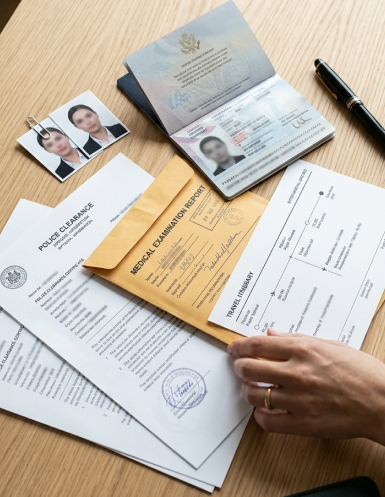
- Valid passport with sufficient validity beyond the intended period of stay.
- Passport sized photographs meeting current USCIS specifications.
- Medical examination results (Form I-693) completed by a USCIS designated civil surgeon.
- Proof of lawful entry into the U.S. where the beneficiary is applying through Adjustment of Status.
- Police clearance certificates from each country where the beneficiary has resided for more than six months.
Additional for marriage-based petitions

- Evidence of a bona fide marriage — including joint financial records, photographs, and travel history.
- Form I-751 (Petition to Remove Conditions) where the marriage was under two years old at the time of green card approval.
Benefits
Family-Based Green Card: The Benefits
Approval of a family-based green card petition does more than change an immigration category. It establishes long-term legal stability for both the beneficiary and the sponsoring family member.
Lawful permanent resident status with the right to live and work in the U.S. indefinitely
Unrestricted employment authorization with no sponsorship or renewal required
Spouses and children under 21 eligible as derivative beneficiaries
Access to certain federal and state public benefits after applicable waiting periods
International travel permitted without losing permanent resident status
Sponsor eligible family members for their own green card after approval
FAQ
What Family-Based Green Card Applicants Ask Most
Can my family member work in the U.S. while the green card application is pending?
Work authorization during the pending period depends on the specific stage of the case. Beneficiaries who have filed Form I-485 may apply for an EAD by filing Form I-765 concurrently. Authorization to work does not begin until the EAD is approved. Beneficiaries who have not yet reached the I-485 stage do not have this option available.
Can I apply for a family-based green card if the beneficiary lives outside the U.S.?
Yes, you can. Beneficiaries outside the US proceed through consular processing rather than Adjustment of Status. After USCIS approves the I-130 petition, the case transfers to the National Visa Center for document collection and fee payment. Once complete, the NVC schedules an immigrant visa interview at the nearest U.S. Embassy or Consulate. The beneficiary enters the US on an immigrant visa and receives the green card by mail after arrival.
How long does the family-based green card process take?
Timelines depend entirely on the category. Immediate relatives of US citizens move fastest because no annual cap applies. For preference category applicants, the wait begins at the priority date — the date USCIS received the I-130 petition — and can run from several months to several decades depending on the category and the beneficiary’s country of birth. India, China, Mexico, and the Philippines historically face the longest backlogs across most preference categories.
What happens if the petitioner dies before the green card is approved?
In most cases, the petition is automatically revoked on the petitioner’s death. However, certain beneficiaries may qualify for humanitarian reinstatement under specific circumstances. Immediate relatives and preference category beneficiaries who had a petition pending or approved before the petitioner’s death may be eligible. The specific facts of the case determine whether reinstatement is possible. Our family-based green card attorney team assesses each situation and advises on available options.
Can I sponsor a family member if I am a lawful permanent resident, not a U.S. citizen?
Yes, but the options are more limited. Lawful permanent residents may only sponsor spouses and unmarried children under F2A and F2B categories. They cannot sponsor parents or siblings — those categories are reserved for U.S. citizens only. Naturalizing to U.S. citizenship significantly expands the range of sponsorable relatives and removes the annual cap for immediate relatives.

Your Family's U.S. Future Starts
Connect with our attorneys today for a clear Family-Based Permanent Residence filing strategy, covering the right category and documents.