or call us at (847) 220-1560
Reliable I-130 Lawyer for Alien Relative Petitions
Most family-based green card cases start with Form I-130. Get it wrong and the process stalls. Missing documents or unanswered USCIS requests can add months to an already long wait. Our I-130 lawyer prepares each petition with the accuracy and supporting evidence it needs to reach approval without unnecessary delays.
Book a Free ConsultationWHY IT MATTERS
The Reality of the I-130 Petition Process
Filing Form I-130 does not grant a visa. It establishes a qualifying family relationship under USCIS standards. From there, the timeline depends on the petitioner’s status and the beneficiary’s country of birth. Immediate relatives of U.S. citizens are not subject to an annual cap. Preference category cases are a different matter. Priority dates and country-specific backlogs can stretch the wait by years.
The Law Offices of Mary Kennedy assesses each case before any filing begins. Our I-130 lawyer identifies the right relationship category, builds the supporting evidence package, and prepares the petition to USCIS standards. As a dedicated immigration law firm, we treat accuracy at this stage as non-negotiable. An error here does not just delay the case. It delays a family.
Eligibility
I-130 Petition: Eligibility Criteria
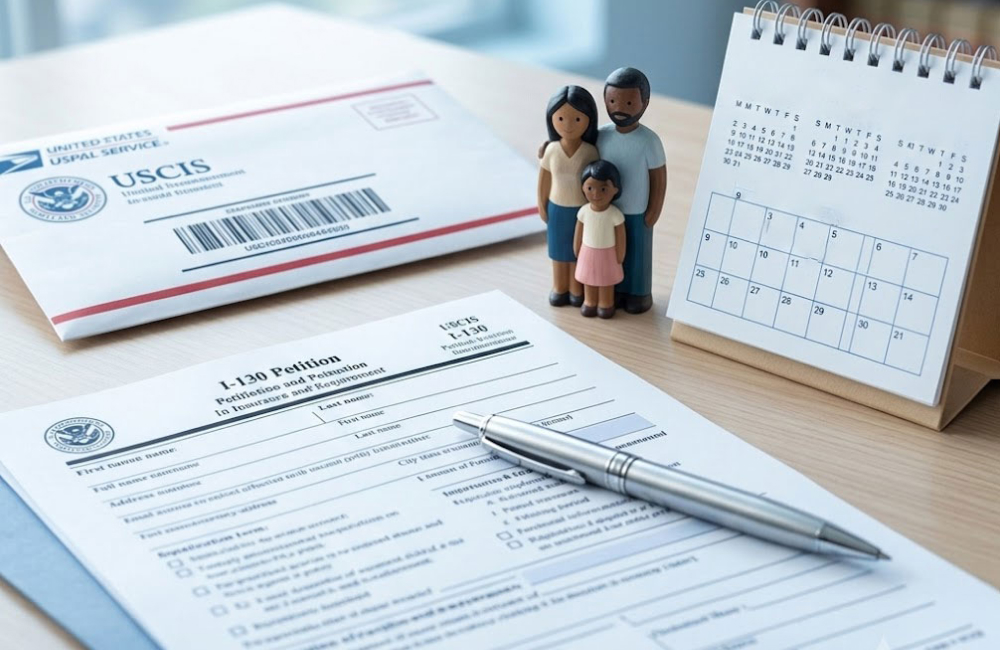
The I-130 sets clear eligibility requirements for both the petitioner and the sponsored relative. Not all family relationships qualify for an I-130 visa petition. Both parties must meet the requirements below before filing begins.
You will need
- The petitioner must be a U.S. citizen or lawful permanent resident. Sponsoring a parent or sibling requires the petitioner to be 21 or older
- The relationship must fall within USCIS-defined categories. U.S. citizens can sponsor more family members than lawful permanent residents, who are limited to spouses and unmarried children
- Documentation proving the claimed relationship is mandatory. A marriage certificate is required for spouses, a birth certificate for children, and proof of shared parentage for siblings.
- The petitioner must submit Form I-864 (Affidavit of Support) showing they can financially support the sponsored relative
- Lawful permanent residents must be residing in the U.S. to file. U.S. citizens can file from anywhere in the world.
- The beneficiary must not have grounds for inadmissibility – including certain criminal records, health conditions, or prior immigration violations
Documentation
I-130 Petition: Required Documents
An incomplete or incorrect I-130 package is one of the most common reasons for delays or rejections. Our I-130 lawyer guides petitioners through each requirement to ensure the filing is accurate before submission.
- 01The petitioner must submit
- Completed Form I-130 (Petition for Alien Relative)
- Proof of U.S. citizenship, such as a birth certificate, U.S. passport, or naturalization certificate. Lawful permanent residents must submit their green card
- Evidence of the qualifying family relationship. A marriage certificate for spouses, birth certificates for children, or shared parentage documentation for siblings
- Form I-864 (Affidavit of Support) – demonstrating financial ability to support the sponsored relative
- Divorce decree, annulment certificate, or death certificate, if either party was previously married
- Two recent passport-size photographs of both the petitioner and the beneficiary, meeting USCIS photo specifications
- 02The beneficiary will also need
Our I-130 lawyer reviews the beneficiary’s documentation to ensure nothing is missing before the consular or adjustment stage.
- Valid passport or government-issued photo identification
- Birth certificate confirming identity and country of birth
- Police clearance certificates from each country of residence are required at the consular interview stage
- Medical examination report from a USCIS-approved physician, required at the immigrant visa or adjustment of status stage
- Previous immigration records, if the beneficiary has prior USCIS filings
The petitioner must submit

- Completed Form I-130 (Petition for Alien Relative)
- Proof of U.S. citizenship, such as a birth certificate, U.S. passport, or naturalization certificate. Lawful permanent residents must submit their green card
- Evidence of the qualifying family relationship. A marriage certificate for spouses, birth certificates for children, or shared parentage documentation for siblings
- Form I-864 (Affidavit of Support) – demonstrating financial ability to support the sponsored relative
- Divorce decree, annulment certificate, or death certificate, if either party was previously married
- Two recent passport-size photographs of both the petitioner and the beneficiary, meeting USCIS photo specifications
The beneficiary will also need
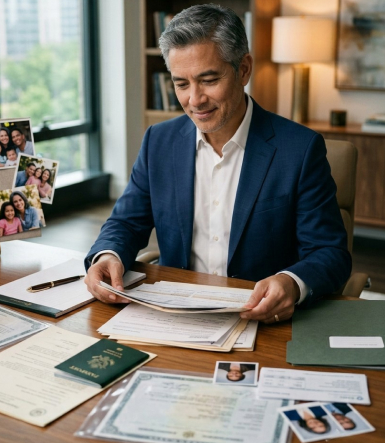
Our I-130 lawyer reviews the beneficiary’s documentation to ensure nothing is missing before the consular or adjustment stage.
- Valid passport or government-issued photo identification
- Birth certificate confirming identity and country of birth
- Police clearance certificates from each country of residence are required at the consular interview stage
- Medical examination report from a USCIS-approved physician, required at the immigrant visa or adjustment of status stage
- Previous immigration records, if the beneficiary has prior USCIS filings

Benefits
I-130 Petition: The Benefits
For U.S. citizens and lawful permanent residents, Form I-130 is the formal starting point for bringing a family member to the U.S. permanently. Our I-130 lawyer explains what a successful petition opens up for both parties.
A legal route for the beneficiary to obtain U.S. permanent residency.
Priority date locked at filing for preference category cases
No annual cap or priority date wait for immediate relatives
Authorization to live and work anywhere in the U.S. once permanent residency is granted
Spouses and children eligible as derivative applicants
Eligibility for U.S. citizenship after meeting naturalization requirements
FAQ
I-130 Petition: Common Questions Answered
How long does the I-130 petition process take?
Processing times vary based on the petitioner’s status, relationship category, and the beneficiary’s country of birth. Immediate relative cases for U.S. citizens generally resolve faster than preference category cases. Preference category cases can take considerably longer, sometimes years, particularly for applicants from India, Mexico, the Philippines, or China. Our team tracks each case and flags issues before they cause avoidable delays.
Can I file an I-130 for my fiancée or an adopted child?
For fiancées, the I-130 is not the correct petition. Bringing an unmarried partner to the U.S. requires a K-1 visa. For adopted children, the I-130 lawyer process applies if the adoption was finalized before the child turned 16 and the petitioner has had legal custody for at least two years. Additional documentation proving the legal adoption is required when filing for an adopted child.
Can the I-130 process be expedited?
Expedited processing is rare and approved only in narrow circumstances. USCIS considers requests involving urgent humanitarian situations, severe financial loss, or critical health issues. There is no guarantee of approval. Decisions are made at USCIS’s discretion. Our team advises on whether your circumstances meet the threshold and how to present the request effectively.
What is the difference between an immediate relative and a preference category?
The distinction determines how long the process takes after I-130 approval. Immediate relatives of US citizens — including spouses, unmarried children under 21, and parents — are exempt from the annual cap and can proceed as soon as their petitions are approved. Preference categories cover all other qualifying relatives and are subject to annual limits. Wait times vary by relationship and country of birth, sometimes stretching years.
What happens after the I-130 is approved?
An approved I-130 does not grant entry to the U.S. It advances the case to the visa stage. For immediate relatives, that means consular processing abroad or Adjustment of Status from inside the U.S. For preference categories, the petition waits until a visa number becomes available under the monthly Visa Bulletin.

Let's move your case forward
Connect with our I-130 lawyer today to get a clear petition strategy tailored to your relationship category and family circumstances.