or call us at (847) 220-1560

Seasoned Naturalization Attorney for U.S. Citizenship Applications
Naturalization is the final legal step between permanent residency and U.S. citizenship. One error in the N-400 application can delay the process by months. Our naturalization attorney team prepares each filing correctly before it reaches USCIS.
Book a Free ConsultationWHY IT MATTERS
Naturalization Is the Final Step. It Is Also the Most Scrutinized One.
When an applicant files Form N-400, USCIS reviews the entire immigration history on file. The civics test and English assessment are only part of the evaluation. Officers assess good moral character over the statutory period, typically 5 years, or 3 years for spousal applicants. Unresolved tax obligations, prior criminal charges, or extended absences from the U.S. can each affect the outcome. In some cases, a naturalization application that surfaces a prior immigration violation can complicate the applicant’s existing permanent resident status.
The Law Offices of Mary Kennedy, an immigration law firm with two decades of experience, reviews each client’s immigration history before the N-400 is filed. Our team of citizenship lawyers identifies potential flags, confirms statutory eligibility, and prepares applicants for the USCIS interview. A well-prepared application does not just improve approval odds. It protects the permanent resident status the applicant already holds.
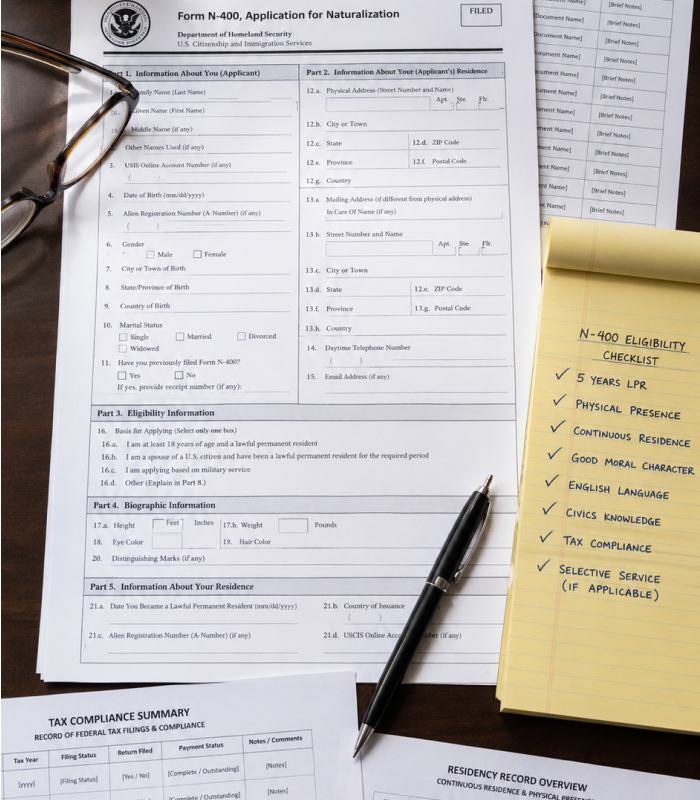

Requirements
Naturalization and Citizenship: Eligibility Criteria
Eligibility depends on how permanent resident status was obtained and the applicant's personal circumstances. The following paths cover the most common qualifying situations.
Standard Five-Year Path
Available to lawful permanent residents who have held a green card for at least five years, with the following requirements:
- Must be at least 18 years old at the time of filing.
- Physical presence in the U.S. for at least 30 of the last 60 months.
- Continuous residence without disqualifying absences throughout the five-year period.
- Must have lived in the state or USCIS district of filing for at least three months.
- Good moral character throughout the five-year statutory period.
- Basic English proficiency in reading, writing, and speaking.
- Must pass the civics test on U.S. history and government.
- Willingness to take the Oath of Allegiance and support the U.S. Constitution.
Three-Year Spousal Path
Available to applicants married to and living with a U.S. citizen for at least three years, with physical presence of at least 18 out of the preceding 36 months. The spouse must have been a U.S. citizen throughout that period.
Military Service Path
One year of honorable peacetime service qualifies an applicant to file while in service or within six months of discharge. Wartime service carries separate conditions with no minimum green card duration or physical presence required.
Surviving Spouse of Military Member
Surviving spouses of U.S. citizens who died during active duty or as a result of military service may apply without meeting standard residence or physical presence requirements.
Documentation
Naturalization and Citizenship: Required Documents
The N-400 application requires documentation from multiple stages of the applicant's immigration and personal history. The following are required across most naturalization cases.
- 01Core documents required for all applicants
- Completed Form N-400 (Application for Naturalization).
- Copy of the front and back of the permanent resident card (Form I-551).
- Valid passport or government-issued photo identification.
- Two passport sized photographs meeting current USCIS specifications.
- Federal tax returns or IRS transcripts for the past three to five years confirming tax compliance.
- Travel records documenting all trips outside the U.S. during the statutory period, including dates and destinations.
- 02Additional documents depending on circumstances
- Marriage certificate and proof of the U.S. citizen spouse’s citizenship status, required for the three-year spousal path.
- Divorce decrees or death certificates from any prior marriages that have been legally terminated.
- Military service records, including discharge papers (DD-214), where the application is based on military service.
- Court records, arrest records, or disposition documents for any criminal matter during the statutory period, regardless of outcome.
- Documentation of any name change if the applicant’s current legal name differs from that on the green card.
Core documents required for all applicants
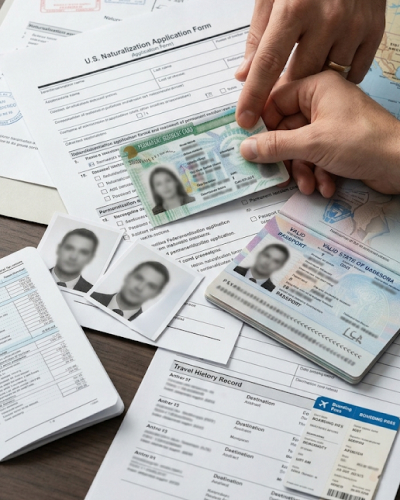
- Completed Form N-400 (Application for Naturalization).
- Copy of the front and back of the permanent resident card (Form I-551).
- Valid passport or government-issued photo identification.
- Two passport sized photographs meeting current USCIS specifications.
- Federal tax returns or IRS transcripts for the past three to five years confirming tax compliance.
- Travel records documenting all trips outside the US during the statutory period, including dates and destinations.
Additional documents depending on circumstances

- Marriage certificate and proof of the US citizen spouse’s citizenship status, required for the three-year spousal path.
- Divorce decrees or death certificates from any prior marriages that have been legally terminated.
- Military service records, including discharge papers (DD-214), where the application is based on military service.
- Court records, arrest records, or disposition documents for any criminal matter during the statutory period, regardless of outcome.
- Documentation of any name change if the applicant’s current legal name differs from that on the green card.
Benefits
Naturalization and Citizenship: The Benefits
U.S. citizenship carries rights and protections that permanent resident status cannot provide. Here is what naturalization makes possible.
The right to vote in federal, state, and local elections
Eligibility for federal government positions requiring U.S. citizenship
Protection from deportation regardless of criminal history
U.S. passport with visa-free access to over 180 countries
Sponsor parents, siblings, and immediate family for immigration
Children born abroad may automatically acquire U.S. citizenship
Eligibility for federal assistance programs restricted to U.S. citizens
Access to U.S. consular services and protection while abroad
Citizenship does not expire and requires no renewal
FAQ
What Naturalization and Citizenship Applicants Ask Most
How do naturalization and citizenship differ?
Citizenship is a legal status, it defines membership in a country. Naturalization is the process through which a foreign national acquires that status by meeting specific eligibility requirements. The two terms describe different things. Naturalization is one of several paths to citizenship, alongside birth on U.S. soil and acquisition through a U.S. citizen parent.
What is the naturalization process step by step?
The process begins with filing Form N-400 with USCIS, which may be submitted up to 90 days before the applicant meets the full residency requirement. After filing, USCIS schedules a biometrics appointment to collect fingerprints and run a background check. The USCIS interview follows, during which an officer reviews the application, conducts the English assessment, and administers the civics exam. USCIS then issues a decision, approval, denial, or a request for additional evidence. Approved applicants are scheduled for an Oath of Allegiance ceremony, at which point the Certificate of Naturalization is issued and citizenship is formally conferred.
How long does the naturalization process take?
Processing times vary significantly depending on the USCIS field office handling the case and current application volumes. Most applicants wait between eight and twenty-four months from filing to the Oath ceremony. The Chicago field office has its own processing timeline, which may differ from national averages. Our naturalization attorney team monitors case status throughout and advises clients when action is required.
What happens if I fail the civics test?
Applicants who do not pass the civics test at the initial interview are given a second opportunity, typically scheduled within sixty to ninety days. The civics exam covers U.S. history and government. An officer asks up to ten questions from a published list of one hundred, and the applicant must answer at least six correctly to pass. Failing on the second attempt results in denial of the N-400 application. USCIS makes the full list of civics questions available to applicants before the interview.
Can I keep my current citizenship after naturalizing as a U.S. citizen?
The U.S. does not require applicants to renounce their existing citizenship as a condition of naturalization in most cases. Whether dual citizenship is permitted depends on the laws of the applicant’s home country. Some countries do not recognize dual citizenship and may treat naturalization in another country as grounds for automatic loss of the original citizenship. Our team of citizenship lawyers advises applicants on the dual citizenship implications specific to their country of origin before filing.

Find Your Path to Citizenship
Speak with our citizenship immigration lawyer team to confirm your eligibility and N-400 application requirements before filing.